GWFP Seminar - Functional Quantum Systems

Europe/Amsterdam
Description

Speaker: Dr. Pavel Bushev

Institute for Functional Quantum Systems (PGI-13)

Forschungszentrum Jülich 

http://www.funqs.de

http://q-solid.de

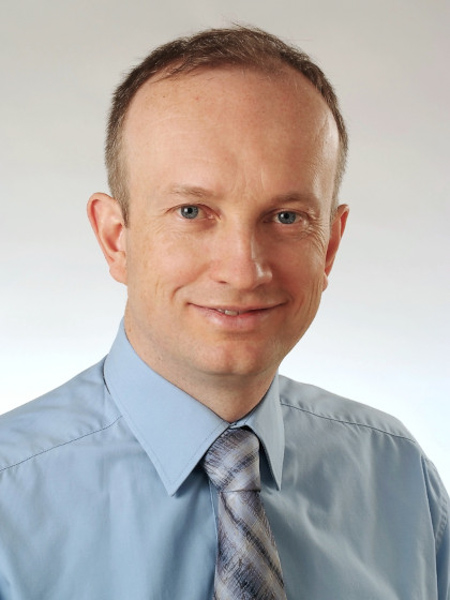
Pavel Bushev portrait


About the speaker (From https://funqs.de/team/pbushev/): Pavel Bushev obtained a Master’s degree cum laude in quantum radio-physics in Moscow Physical Technical Institute (Moskau, Russische Föderation) in 1997. During his doctoral research in Innsbruck University he worked on experiments with single trapped barium ion and a single photon. Pavel performed first experiments on quantum-limited motion detection and feedback for which he obtained a PhD degree cum laude. After a two-years postdoc in ETH Zürich and 2 years in Ulm, he worked as senior research assistant in Karlsruhe Institute of Technology for 4 years during 2009-2013 on investigations of superconducting qubits and hybrid quantum systems. In 2013 he joined the department of experimental physics in Universität des Saarlandes as assistant professor. The research topic of his group was mainly focused on quantum microwave photonics and metrology.

Registration
Participants
Participants
  • Gobind Kumar
  • Jeremie Gobeil
  • Nikita Shcheblanov
  • Sander Wolters
  • +3
    • 11:00 12:00
      status of QSOLID project and TWPAs

      In this talk, I will present the current status and development logic of the QSOLID project, which aims to build a scalable superconducting quantum computing platform. A central focus is our 10-qubit architecture, which we use as a controlled engineering demonstrator rather than a mere proof of principle. Even at this scale, material limitations, readout-chain imperfections, and amplifier-induced constraints manifest themselves in a non-negotiable way.
      I will also discuss our progress on novel coherent materials and fabrication strategies for Traveling-Wave Parametric Amplifiers (TWPAs), and analyze their impact on the overall quantum efficiency of the readout chain.
      Particular emphasis will be placed on speeding up measurement and initialization, which remains a key challenge for scalable quantum computing. We experimentally demonstrate a dispersive measurement scheme for superconducting qubits that simultaneously measures the qubit state and actively resets the readout resonator to its initial state, enabling faster measurement cycles without residual photon population.
      The underlying message is intentionally conservative: before claiming hundreds of qubits, one should first learn how to control, calibrate, and read out ten of them accurately and reproducibly.
      References:
      M. Jerger et al., Dispersive Qubit Readout with Intrinsic Resonator Reset, arxiv:2406.04891